The Signal Is Not the Strategy: A Review Model for AI-Personalized GTM Messages
The signal is not the strategy. A useful message begins when context changes the GTM decision, the argument, and the recipient's reason to respond.
A practical review model for turning GTM signals into better decisions, defensible messages, and credible reasons to respond.
AI personalization fails without context because a model can insert a true company detail while leaving the business reasoning unchanged. To review a personalized message before sending or automating it, trace the reasoning from the verified signal to the business situation, GTM objective, proof, ask, and review boundary.
- A signal is an input, not a strategy or a reason to send.
- Personalization begins when context changes the angle, timing, offer, proof, ask, or next step.
- Public product documentation supports that GTM signals can feed scoring, workflows, research, prioritization, and AI-assisted outreach; it does not support treating signals as proof of intent or performance lift.
- The sender's GTM objective and the recipient's reason to respond are related, but they are not the same thing.
- Evidence, inference, and generated language should be reviewed separately.
- If removing the custom detail leaves the same argument intact, the detail is probably decorative.
- AI should generate at scale only after operators define what the context is supposed to change and where review, sampling, suppression, or human approval belongs.
The Custom-Line Trap
A company is hiring several SDRs. The signal is real. A personalization system finds it, writes a first line about the open roles, and then returns to the same pitch it would have sent to any other account. The output looks researched. It is not yet strategic.
The hiring signal might indicate new ownership, a capacity problem, a process rebuild, a ramp challenge, or nothing relevant to the seller at all. Until the team decides which interpretation is plausible, what evidence supports it, and what should change in the motion, the custom line is decoration around a generic argument.
We call this the custom-line trap: treating a prospect-specific sentence as proof that the message is relevant. A detail can be accurate while the outreach still lacks a business reason to exist.
The operating question is not whether AI can mention the signal. It is what GTM decision the signal should change. A weak interpretation repeated once is a bad message. A weak interpretation automated across a market becomes a bad operating system.
What Personalization Must Accomplish
Personalization in GTM is the use of buyer, account, market, or conversation context to shape a GTM action or message around a defined objective. Its job is not merely to prove that research happened. Its job is to make a better decision about who should receive a message, why it should exist now, what argument it should make, and what response it can reasonably invite.
That creates two tests. The sender-side test is the GTM objective: what should context change about account priority, routing, timing, angle, offer, proof, ask, or the next internal step? Book a meeting is not precise enough. The operator needs to know what the message is trying to learn, confirm, correct, or advance.
The recipient-side test is the reason to respond. A useful response may be a correction, confirmation, referral, resource request, stakeholder introduction, meeting, or agreed next action. It should follow from the recipient's situation, not only from the sender's desire for pipeline.
The central stance is an operator thesis, not a universal benchmark claim: the signal is not the strategy. Personalization begins when context changes the GTM decision, message, and reason to respond.
Message Anatomy At A Glance
Use this breakdown to review any AI-personalized GTM message before it is sent, sampled, or automated.
| Part | Review question | Failure mode |
|---|---|---|
| Signal | What observable event, behavior, attribute, or conversation input started the message? | The message reports a fact without knowing what it changes. |
| Context | What account, role, timing, source, fit, or workflow context changes the interpretation? | The system treats a raw signal as enough. |
| Interpretation | What is proven, what is inferred, and what alternative explanation is plausible? | The message writes a hypothesis as fact. |
| GTM decision | Did priority, route, timing, angle, offer, proof, ask, next step, or suppression change? | The signal becomes a custom first line on the same generic pitch. |
| Proof | What can the sender responsibly point to? | The proof is a logo, benchmark, or claim that does not match the situation. |
| Ask | What can the recipient usefully confirm, correct, receive, redirect, or advance? | The ask jumps straight to a meeting without earning it. |
| Review boundary | Should the system send, sample, route for review, suppress, or gather more context? | Automation scales an unsupported inference. |
The Anatomy: From Signal to Review
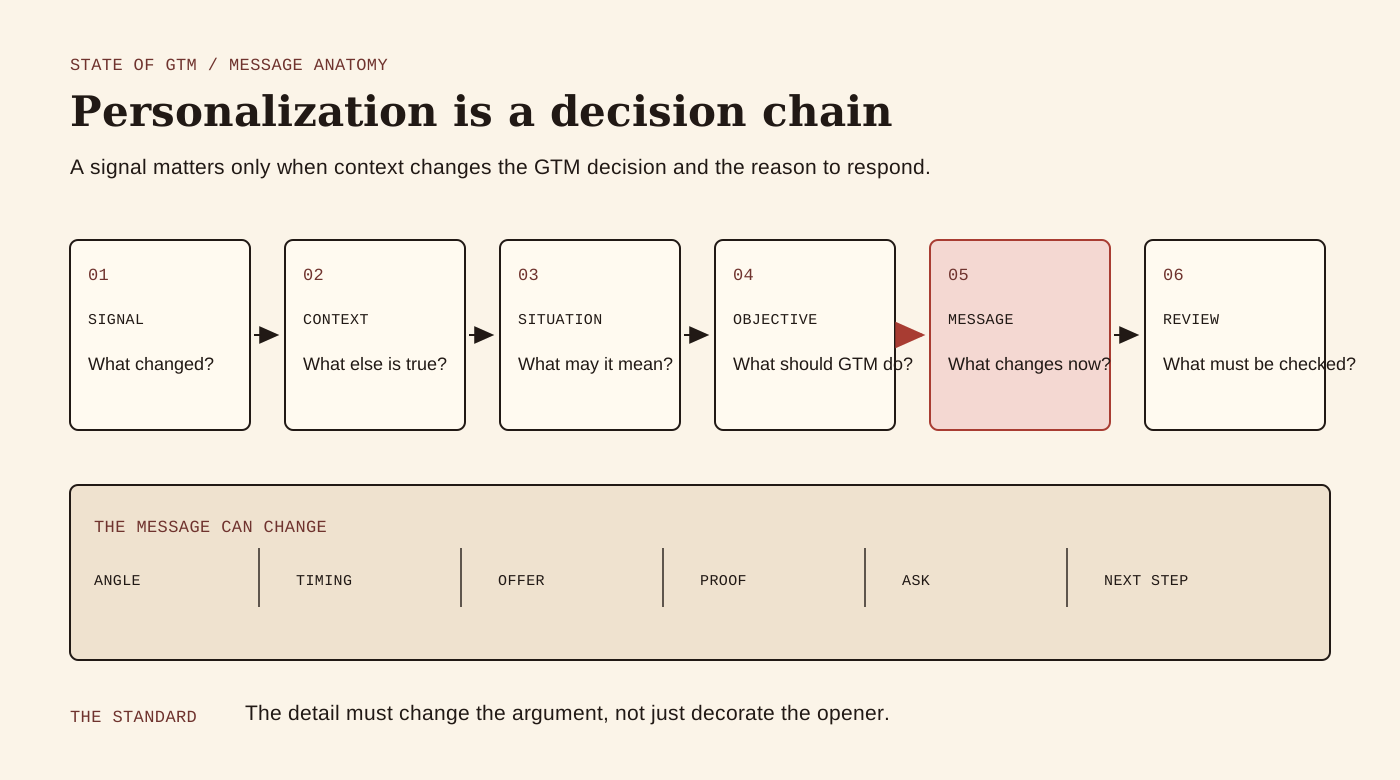
A personalized message should be reviewable as a chain of decisions: signal, context, business situation, GTM objective, proof, ask, and QA.
The signal is the observable event, attribute, behavior, or conversation input that starts the reasoning. Context is what else the operator needs to interpret it. The business situation is what may be happening operationally and should remain a hypothesis when the evidence does not prove it.
The GTM objective identifies the decision that should change. Proof is what the sender can responsibly point to. The ask should be proportionate to the evidence and the recipient's likely state. QA verifies source quality, freshness, inference strength, sensitivity, usefulness, and next-step fit.
The chain can stop. Sometimes the right decision is to suppress the message, route the account differently, or gather more context. Generation is not the required output of every signal.
What Public Sources Prove and Do Not Prove
The available public documentation makes one part of the article stronger and one part stricter. It shows that the raw materials for AI-personalized GTM are no longer hypothetical: platforms can expose signals, score or route records, assemble research context, review conversations, and generate outreach drafts.
Those sources do not prove that any signal family creates buying intent, that AI-written personalization performs better, or that a custom detail is useful without a defensible interpretation. Signal availability and workflow capability are not the same as buyer relevance or performance lift.
The safest article claim is narrower and more useful: modern GTM teams have more signal inputs and AI-assisted workflow surfaces than before. The operating gap is deciding which signals are eligible, what they mean, what GTM action should change, and where review must stop automation.
The Signal Supply Chain
The practical version of the system is not a bigger prompt. It is a short supply chain that stops weak evidence before it becomes fluent copy: source, eligibility, interpretation, GTM decision, proof, ask, review, and learning.
Source asks where the signal came from and whether it is allowed for this motion. Eligibility asks whether the account, person, region, relationship state, and timing belong in the workflow. Interpretation separates what happened from what the team only infers.
The GTM decision names what should change: priority, routing, timing, research, offer, proof, ask, next step, suppression, or nothing. Proof identifies what the sender can responsibly reference. The ask names what the recipient can usefully confirm, correct, receive, redirect, or advance.
Review decides which claims, sources, and inferences need sampling or human approval before scale. Learning changes rules, thresholds, examples, or suppressions after corrections and outcomes; it does not merely rewrite the next message.
The Five-Signal Method
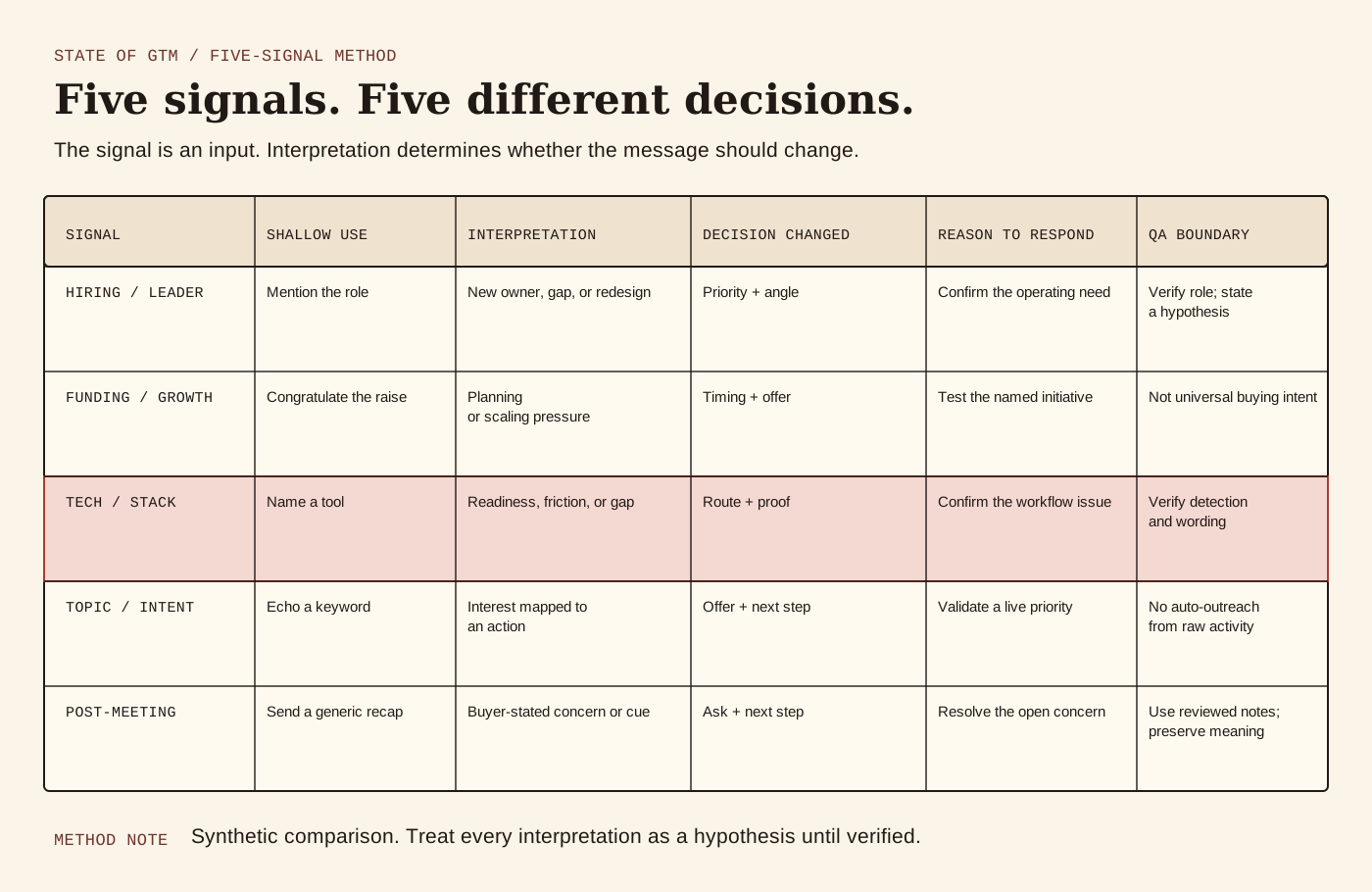
The difference between a signal and a strategy becomes clearer when common signal families go through the same test. This is a structured editorial demonstration, not a benchmark study. Public sources support that these signal families can exist in GTM workflows; the table shows how State of GTM would review their interpretation before action.
No row below proves that a signal will improve reply rate, conversion, pipeline, or revenue. The comparison is diagnostic: the same visible signal can support several situations, and each situation can require a different GTM decision. Detecting the signal is therefore not enough.
| Signal | Shallow use | Interpretation | Decision changed | Reason to respond | QA boundary |
|---|---|---|---|---|---|
| Hiring or leadership | Mention the role | Ownership, capacity, process, or enablement may be changing | Priority, angle, account brief, or ask | Confirm or correct the operating need | Verify role and timing; use hypothesis language |
| Funding or financing | Congratulate the raise | New targets, expansion pressure, or a planning window may exist | Timing, route, offer, or suppression | Confirm whether financing connects to an active initiative | Never treat funding as universal intent |
| Technology change | Name a tool | Readiness, integration friction, adoption, or workflow maturity may have changed | Segment, route, problem angle, or proof | Confirm the actual workflow constraint | Verify stack data; avoid private configuration claims |
| Intent or topic interest | Echo a topic | The activity may reflect a live priority, early research, or noise | Resource, handoff, reviewed outreach, or no action | Validate whether the topic maps to a real initiative | Do not automate from raw activity alone |
| Post-meeting context | Send a generic recap | A stakeholder, objection, timing, or next-step issue may now be known | Follow-up, owner, proof, brief, or next action | Confirm the unresolved concern or progression | Use reviewed notes; do not invent urgency or agreement |
Hiring or Leadership Change
Hiring is useful because it tempts the sender to confuse visibility with meaning. An open role is public and easy to mention. It does not, by itself, prove budget, urgency, a broken process, or interest in the seller's category.
A new RevOps leader may be rebuilding ownership. A group of SDR openings may create a ramp or data-readiness question. A replacement search may indicate continuity rather than expansion. The operator's task is to choose the narrowest defensible interpretation and change the motion accordingly.
The right output might be a different angle, a confirmation-oriented ask, an account research task, or no outreach. The signal earns attention only after it changes a decision.
Funding or Growth Financing
Funding is one of the clearest examples of a signal being mistaken for intent. The event may open a planning window, introduce new targets, fund expansion, or have little connection to the seller's problem.
Congratulations on the raise establishes recognition, not relevance. A stronger workflow asks what the company said the financing is for, which teams appear affected, whether the timing is current, and whether the seller has proof that fits the proposed initiative.
If those links are missing, the safe choice is softer wording, a smaller ask, or suppression. Financing can inform timing. It cannot carry the whole argument.
Technographic or Sales-Tech Change
Technology data can describe a tool, but the business meaning lives in the workflow around it. A new system might indicate readiness. It might also create integration work, duplicate processes, low adoption, or no relevant change at all.
The useful question is not what tool the company uses. It is what operating constraint the change could create and what the sender can responsibly verify.
That interpretation might change the problem angle, the proof offered, the person routed into the conversation, or whether the account belongs in the motion. Claims about private configurations, migration pain, or dissatisfaction should not be invented from stack data.
Intent or Topic Interest
Intent and topic activity require an explicit confidence model. Reading about a topic can mean an active project, early education, curiosity, or noise. The activity becomes useful only when the team can map it to an appropriate action.
High-confidence activity might trigger reviewed outreach. Lower-confidence activity may justify a resource, an internal handoff, more research, or no action. The offer and ask should match the strength of the evidence.
Raw activity should not be treated as permission to assert a priority the buyer has not expressed.
Post-Meeting or Call-Note Context
Post-meeting context is different because much of the relevant information came from the buyer rather than from a public signal. It can reveal an unresolved objection, a stakeholder gap, an agreed next step, or a timing constraint.
This is the lowest-confidence signal family in the current research bank and is included to test whether the framework extends beyond cold outbound. It is an illustrative workflow case, not an equally established operator pattern.
The operator still has to separate what was said from what the system inferred. A follow-up should preserve the buyer's language, ownership, and level of commitment without manufacturing agreement or urgency. Good personalization here often looks less like a clever sentence and more like accurate continuation.
What Context Can Actually Change
Across the five signals, context earns its place when it changes at least one message variable: the angle that leads, the timing, the offer, the proof, the ask, or the next step after a response or internal handoff.
Changing a word, inserting a company fact, or rewriting the opening does not necessarily change any of those variables. Surface variation can produce many unique messages without producing meaningful personalization.
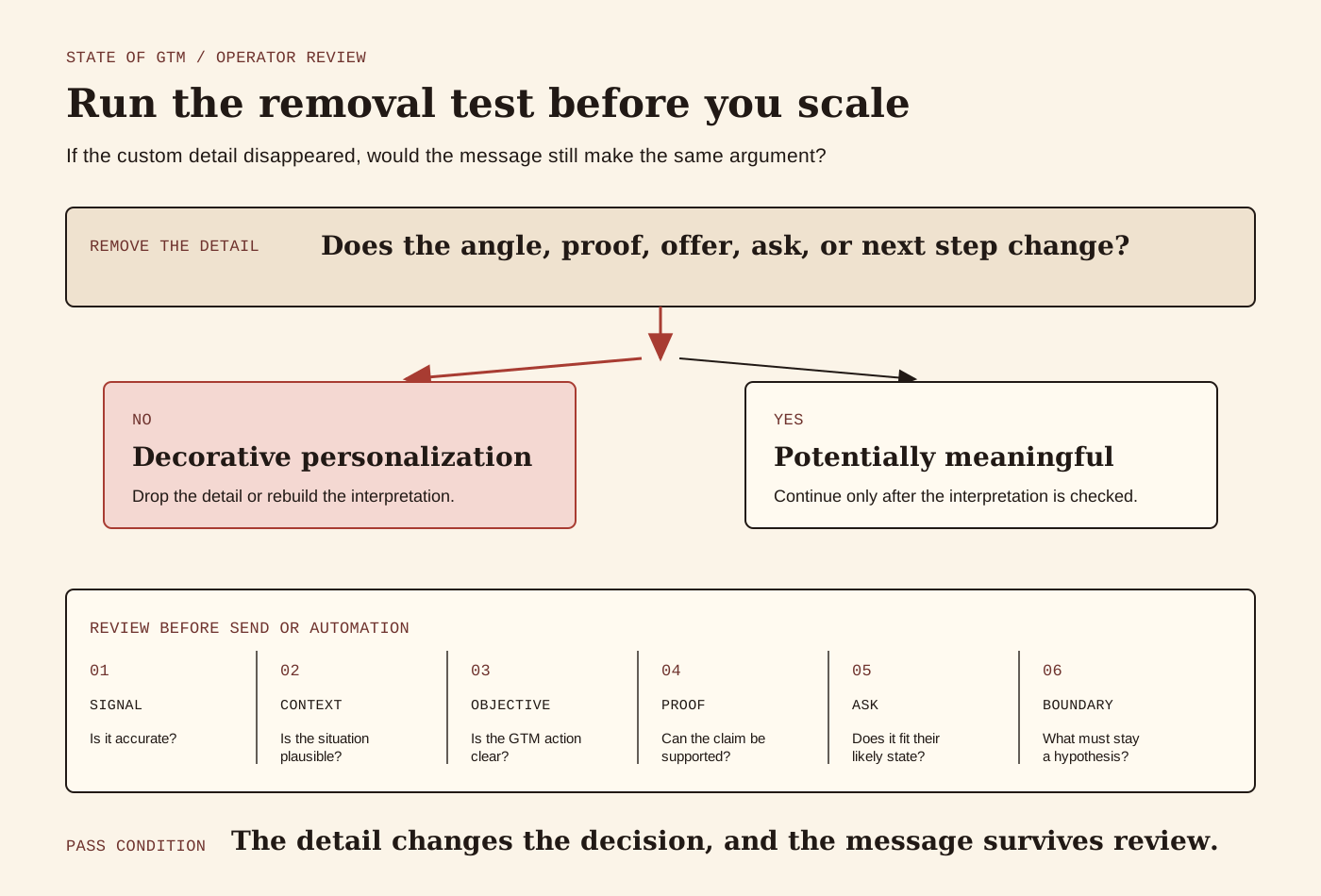
Use the removal test: would the message make the same argument if the custom detail disappeared? If yes, the detail is probably decorative. If no, run a second test: does the detail actually support the argument, or does it merely make an unsupported inference sound specific?
Synthetic Example: Hiring
Signal: a company is hiring its first sales operations leader and several SDRs. Shallow message: I noticed you are growing the sales team. We help companies like yours generate more pipeline. Open to a quick call?
Interpretation: the team may be formalizing process ownership while adding frontline capacity. That creates a plausible question about whether routing, data, and operating definitions are ready for the new hires. It does not prove a problem.
Changed message: You are adding SDR capacity while hiring the first sales operations owner. Teams at that stage often have to decide whether lead routing and account definitions are stable enough to support the ramp. Is that already settled, or is it part of the new leader's remit?
The angle moved from generic pipeline generation to operating readiness. The ask moved from a meeting request to confirmation or correction. Verify that the roles are current and accurately described; do not claim that hiring proves urgency or a routing problem.
Synthetic Example: Funding
Signal: a company announced a growth financing round. Shallow message: congrats on the funding. We help companies like yours turn growth into pipeline. Worth a quick call?
Interpretation: funding may create a planning window, new targets, expansion pressure, hiring plans, or no relevant buying motion. The signal supports a question about what changed operationally. It does not prove budget, urgency, or purchase intent.
Changed message: After a growth round, GTM teams often have to decide which targets, territories, and reporting assumptions need to change before hiring gets ahead of the operating model. Is that planning already locked, or still being worked through?
The angle moved from congratulation to planning pressure. The ask invites correction about the operating window instead of assuming the buyer has budget or a live project. Verify the announcement, timing, company fit, and recipient role before using it.
Synthetic Example: Technographic Change
Signal: a company appears to have added a new sales-engagement platform. Shallow message: saw that you use this tool. We integrate with it and can help your reps book more meetings.
Interpretation: the addition could reflect a workflow redesign, consolidation, experimentation, or ordinary procurement. The relevant hypothesis is not tool ownership; it is whether data flow, routing, governance, or adoption changed.
Changed message: It looks like the engagement layer changed recently. When that happens, RevOps usually has to decide which routing and account rules remain upstream and which move into the new workflow. Are you keeping that logic in the CRM, or reworking it with the rollout?
The angle moved from integration recognition to workflow ownership. The ask invites a correction about architecture instead of presuming pain. Confirm the technology signal and do not assert a migration, configuration issue, or dissatisfaction that is not public.
Synthetic Example: Post-Meeting Context
Signal: reviewed notes show that a prospect wants to proceed but needs the finance stakeholder to validate the business case. Shallow message: great speaking today. As discussed, here are the next steps. Let me know if you have questions.
Interpretation: the unresolved work is not another generic follow-up. It is giving the current contact a credible way to involve finance without overstating agreement.
Changed message: You said the operating case is clear, but finance will need to see how the current manual work translates into cost and risk. I have attached a one-page model with the assumptions left visible. Would it help to review those assumptions together before you bring finance in?
The offer became a decision aid, the proof matched the named stakeholder concern, and the ask became preparation for the next step. Check the notes for the exact stakeholder, concern, and level of agreement; do not imply consensus, timing, or commitment the buyer did not state.
Common Failure Modes
The signal becomes the message when the sender reports a hiring event, funding round, tool, or topic without deciding what it changes. The inference becomes fact when a plausible situation turns into an unsupported claim about budget, pain, urgency, or priorities.
The objective becomes seller activity when book a meeting replaces the more useful question of what the message should confirm, correct, route, or advance. The reason to respond disappears when the message explains why the seller is interested but not why the recipient should spend attention on the exchange.
The ask is too large when a low-confidence signal leads directly to a high-commitment request. The proof does not fit when a generic customer logo is offered where the interpretation requires evidence about workflow, ownership, or a specific operating decision.
Automation begins too early when the team scales generation without defining source quality, confidence, suppression, sensitivity, or human approval. Tone review then substitutes for reasoning review: the message can be concise, grammatical, and on-brand while still being irrelevant or unsupported.
A Practical Review Model Before Scale
The review should end in one of five decisions: send, sample, human review, gather context, or suppress.
First, verify the signal. What happened, where did the information come from, is it current and safe to use, and does it belong to this account, person, and time window?
Second, bound the interpretation. What does the signal prove, what is inferred, what alternative explanations are plausible, and should the situation be stated as a question or hypothesis?
Third, name the GTM decision. What changes because of the context: priority, route, angle, timing, offer, proof, ask, next step, or suppression? Who owns that decision, and would the workflow behave differently without the signal?
Fourth, establish the reason to respond. What useful thing can the recipient confirm, correct, receive, or advance? Is the ask proportionate to the evidence and respectful of the recipient's role and likely state?
Fifth, review the generated message. Is evidence distinguishable from inference? Does every claim have support or clear hypothesis language? Does the proof fit? Does the removal test expose decoration? Could the message create risk through sensitivity, false certainty, or invented familiarity?
Finally, decide the automation boundary. Which steps can run automatically, which signals require sampling or approval, what confidence should suppress a message, and what feedback will change the rules rather than merely rewrite the copy?
| Decision | Use when | Typical owner |
|---|---|---|
| Send | Signal is verified, interpretation is bounded, ask is proportionate, and no sensitive inference is being made. | Account owner or campaign owner |
| Sample | Pattern is promising but unproven; review a small batch before expanding. | RevOps, sales leader, or campaign owner |
| Human review | The signal is sensitive, the inference is high-impact, or the proof boundary is easy to overstate. | Account owner, manager, or legal/compliance where relevant |
| Gather context | The account fits, but the source, timing, role, owner, or business situation is unclear. | Researcher, SDR, AE, or RevOps |
| Suppress | The account is out of fit, already active elsewhere, source quality is weak, or the inference would be inappropriate to use. | RevOps or campaign owner |
The Operator Standard
AI can make weak personalization look polished and produce it quickly. That is why the operating standard must sit upstream of generation.
The operator's job is to decide whether the signal is reliable, what situation it may indicate, what GTM objective should change, what the recipient can usefully respond to, and where the system must stop for review. The model can help produce options after those decisions exist. It should not quietly make them on the team's behalf.
The signal is not the strategy. The custom detail is not the reason to send. The message becomes personal when the context changes the argument and creates a credible next exchange.
Do not ask AI to personalize the message until you know what the context is supposed to change.
What is AI personalization in GTM?
AI personalization in GTM uses buyer, account, market, or conversation context to shape a GTM action or message around a defined objective. It is more than inserting a prospect-specific fact into generated copy.
How do you review a personalized sales message?
Verify the signal, separate evidence from inference, identify the business situation, name the GTM decision that changed, check the recipient's reason to respond, and review the proof, ask, sensitivity, and automation boundary.
Why does AI personalization fail without context?
AI personalization can fail when teams skip the interpretation layer. They detect a signal, generate a custom line, and send a generic argument without deciding what the signal changes or what the recipient can usefully respond to.
What is the custom-line trap?
The custom-line trap is treating a prospect-specific detail as proof that the message is relevant, even when the detail does not change the message's underlying argument.
What should GTM teams do instead of AI custom lines?
Start with the decision, not the sentence. Verify the signal, add the context needed to interpret it, decide whether priority, routing, timing, angle, proof, ask, next step, or suppression should change, then let AI draft inside those boundaries.
What is the removal test for personalization?
Remove the custom detail and ask whether the message still makes the same argument. If it does, the detail is probably decorative. If it does not, verify that the detail truly supports the argument.
Which signals can support message personalization?
Hiring, leadership changes, funding, technology changes, topic interest, intent, and reviewed conversation notes can all provide useful inputs. None is inherently strategic; each requires interpretation and an appropriate GTM action.
Should every signal trigger an automated message?
No. A signal may change account priority, routing, research, an internal handoff, or suppression instead. Generation is only one possible action.
What should humans review before personalized outreach scales?
Humans should define source and confidence standards, inspect high-risk inferences, approve sensitive uses, test whether the context changed the message, and confirm that the ask and next step fit the evidence.
Get the next GTM context briefing
Subscribe for future analysis on AI-assisted outbound, signal quality, and buyer relevance.